
Hanabi
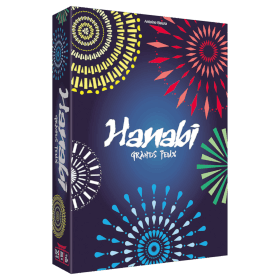 In this collective game, all the players work together to create a beautiful firework display.
But every player has to hold his cards back to front: you cannot see your own cards!
So you have to give your partners smart advice and remember all the information collected.
Spēlētāju skaits: 2 - 5
Spēles ilgums: 10 mn
Sarežģītība: 2 / 5
Spēlē Hanabi un 1408 citas spēles tiešaistē.
Nekas nav jākačā - spēlē pa tiešo no pārlūka.
Ar saviem draugiem un tūkstošiem spēlētāju no visas pasaules.
Par brīvu.


Spēlē Hanabi un 1408 citas spēles tiešaistē.
Nekas nav jākačā - spēlē pa tiešo no pārlūka.
Ar saviem draugiem un tūkstošiem spēlētāju no visas pasaules.
Par brīvu.
Noteikumu kopsavilkums
Overview
Hanabi is a cooperative game where your collective goal is to build a fabulous fireworks show. Like any decent show, you should start with small fireworks and finish with the big ones. You will do this by playing red, yellow, green, blue and white cards from ranks 1 to 5. The problem? You don't know what cards you have. But you know which ones your fellow players do. So you must communicate with each other to build a proper show by placing cards in sequential order with no misfires.
Cards and Firework Stacks
The deck has 50 cards. The cards come in five colors: red yellow green blue white
Each color has 10 cards: 3 card1, 2 card2, 2 card3, 2 card4, 1 card5.
There is only one firework stack of each color which start empty. redyellowgreenbluewhite
Each firework must be placed in ascending order starting from 1, so you are aiming for red5yellow5green5blue5white5.
Playing a card on any stack that is not the next number in the sequence will result in a misfire. If three misfires occur, the game is over and the players lose.
Communication
You communicate with your teammates via clues. You have a limited number of clues, represented by tokens like this: clue tokens
Each time a clue is given, one clue tokens moves from the white area (available tokens) to the black (used tokens): clue tokens clue tokens clue tokens clue tokens clue tokens clue tokens clue tokens7 clue tokens.
If there are no tokens available, you must play or discard on your turn.

Setup
In a 2-3 player game, each player gets a hand of 5 cards. In a 4-5 player game, each player gets a hand of 4 cards.
Gameplay
On your turn, you can do one of three things.
- Give a clue.
- Discard a card.
- Play a card.
Give a Clue
To give a clue, there must be at least 1 clue tokens in the white area. Select another player's card. You have the choice of telling the player:
- Which cards of that color the player has
- Which cards of that number the player has
At that point, 1 clue tokens is moved from the white "available" zone to the black "used" zone.
The game records these clues, so you can tell which cards other players have pointed out are what number and what color.
Play a Card
Select a card in your hand and then or just drag the card onto the firework stacks in the center to play it.
- If it is the next card in sequence for a color, it is automatically placed on the appropriate stack, adding to or completing the firework stack.
- If it is not the next card in sequence for any color, then the firework has misfired and the card is discarded.
A replacement card is automatically added to the left side of the player's hand.
If the played card completes a firework stack, 1 clue tokens moves from the spent black area to the white available area.
Discard a Card
To discard a card, there must be at least 1 clue tokens in the black area.
Select a card in your hand and then or just drag the card onto the discard area to discard it.
A replacement card is automatically added to the left side of the player's hand.
1 clue tokens moves from the black area to the white area, making it available.
Discarding is a necessary part of the game as you will need to restore clue tokens in order to clue more cards.
Game End
There are three ways the game can end:
- If the players cause 3 misfires (misplayed cards), the game immediately ends and the players lose.
- If all 5 firework stacks are completed, the players have won and are granted a stunning victory with 25 points.
- If the deck is empty, each player plays one more time (including the player who emptied the deck).
Scoring
The score is automatically counted as the game progresses, visible in the player panels.
Artistic impression is determined by the Artisan League of Fireworks Technicians reference scale:
| Points | Overall impression |
|---|---|
| 0-5 | Horrible, booed by the crowd... |
| 6-10 | Mediocre, just a spattering of applause... |
| 11-15 | Honorable attempt, but quickly forgotten... |
| 16-20 | Excellent, crowd pleasing. |
| 21-24 | Amazing, will be remembered for weeks! |
| 25-29 | Legendary, everyone left speechless, stars in their eyes! |
| 30 | Divine, the display outshines the stars! |
The only way to score above 25 is to include multicolored cards. See Variants below.
Variants
Colors
| Name | # of Cards | Definition |
|---|---|---|
| Normal | 5 colors | Play with a 50-card deck of 5 colors (red, yellow, green, blue, white) to make 5 firework stacks. |
| Tricky | 6th color (10 cards) | Add a sixth color--multicolor--to make a deck of 60 cards and make 6 firework stacks. |
| Difficult | 6th color (5 unique cards) | Same as Tricky, except multicolor cards only have one card of each rank:
1 multicolour1, 1 multicolour2, 1 multicolour3, 1 multicolour4, 1 multicolour5 This variant is always played in friendly mode because the score depends too much on the luck of the draw to reflect true skill.
|
| Avalanche of Colors | Multicolor (10 multicolor cards) | multicolor cards are wild, which means these cards are clued by any color. |
Black Powder
Ten black cards are added to the deck. Black cards are played in descending order (from black powder5 to black powder1). This is why instead of three 1s and one 5, there are three 5s and one 1.
You cannot give color clues for black cards. They have no color (who can see a black firework?). So black cards can only be clued with number.
The game score starts at -5. That's -1 point for every card missing from the black powder stack.
5 Flamboyants
Also known as "The Sumptuous 5". When you play the last card on a firework stack (typically the 5), a bonus tile is randomly selected for immediate use. Bonus tiles have different effects:
- Gain a clue tokens
- Gain a clue tokens and remove 1 misfire
- Give a color clue to a player for free
- Give a number clue to a player for free
- Shuffle a discarded card back into the deck
- Play a discarded card
Convention Used
Hanabi is a game about communication, but there aren't enough clue tokens to be able to indicate both color and number of every played card. So to give more information, the team must agree on a set of interpretations for clues, plays, and discards, called conventions.
If the players use different conventions to communicate, they are sure to lose. You can read more about conventions on the Tips page.
During game setup, the creator can indicate which convention set the players should use. These are not enforceable, so please respect the convention set that the table creator set.
| Convention set | Summary | Reference |
|---|---|---|
| Unspecified | No convention set | |
| Finesse |
Players assume every marked card is useful.
Useless cards are discarded in priority e.g. cards marked blue when the blue stack is completed. |
Reference |
| Layered Finesse | Same as Finesse with the addition that finessed cards can also be layered behind other unrelated, but playable cards. | Reference |
| Hgroup | This is a comprehensive convention set with several detailed interpretations, many based on the last card (known as the "chop card") and order of clues given. See reference for more details. | H-Group |
| Other | You can specify which convention set should be used in the table presentation header of the table when it starts. |
Preset Deck
Preset decks are useful for comparing teams/conventions using the same deck. You can select to have no preset deck or choose one of 5 preset decks of the day. These change every day at 0:00 UTC.
Unofficial variant
In a two-player game, hand size is 6 instead of 5. In a five-player game, hand size is 3 instead of 4.